Your Blood Test, Your Genes, Your Air: Read Together
A fictional person in New Delhi: an inflammation marker that rose but stayed under the usual cut-off, two gene variants studied with inflammation, and eight weeks of smog. What VitaCrypt shows when it reads them together, why the card says Hypothesis, and how a daily habit changes with the air.
A rising inflammation marker, two gene variants and eight weeks of smog in New Delhi, and what VitaCrypt shows when it reads them together
A number that looks fine
Alex's first two blood tests both measured hs-CRP, a marker of low-grade inflammation in the blood. It went from 1.6 to 2.1 mg/L. Both values are under 3, the upper cut-off the American Heart Association uses for this test, so each report on its own looks unremarkable. It is the kind of result that gets filed away, with nothing on the page to say whether the change means anything.
The page also leaves out the city. VitaCrypt's demo can place Alex in several cities, and this piece follows Alex in New Delhi. In the eight weeks before the second test, fine particles in the air there, PM2.5, averaged 125 micrograms per cubic metre. The World Health Organization's guideline for a single day is 15. All 56 days were above it, and the worst reached 230.8. On the day of the test the US air quality index stood at 191, in the band officially called "Unhealthy".
Then there is the DNA file from a consumer genetic test. It carries variants in two genes, IL6 and TNF, that researchers study in connection with inflammation.
Alex is a fictional person. The blood tests, the DNA and the habits in the demo are synthetic. The air is real: daily values from the Open-Meteo archive, recorded in New Delhi between 18 November 2025 and 12 January 2026 and moved onto Alex's dates.
Where each fact lives
Usually each of these facts lives somewhere different. The lab sends a PDF, the DNA company keeps its report in its own app, and the air quality app on the phone has never seen a blood test. Each is right about its own number, and none of them can tell Alex that the three might be connected.
VitaCrypt puts them in one place. It is an early-stage MVP, a first version that anyone can try as a demo. Alex's profile holds six sources: blood tests, the DNA file, sleep, steps and heart rate from a wearable, eight short questionnaires, a gut microbiome report, and the air in the city. VitaCrypt reads the whole profile and suggests what might be connected. Each suggestion is then checked against published research.
What the card says
When I ran the demo for Alex in New Delhi, one of the cards was titled "Watch inflammation in heavy-pollution months". It has three rows: the eight-week air summary, hs-CRP going from 1.6 to 2.1, and the IL6 and TNF variants.
Each connection on the card is checked on its own. It counts as Cited when papers in research databases such as PubMed and Europe PMC support it. Opening the card shows how many of its connections were confirmed, and one more tap lists the papers. Fine particles and CRP have been studied together, and so have these gene variants and inflammation.
The card as a whole says Hypothesis, with the line "Combination is our hypothesis". Research has looked at each connection separately. No study has looked at this one person, with these variants, this lab trend and this winter, and concluded that the three belong together. Joining them is VitaCrypt's step, and the card says so in plain words.
The card leaves open whether the air raised Alex's CRP. Three things turned up together, research supports each part, and the whole is worth raising with a doctor at the next appointment.
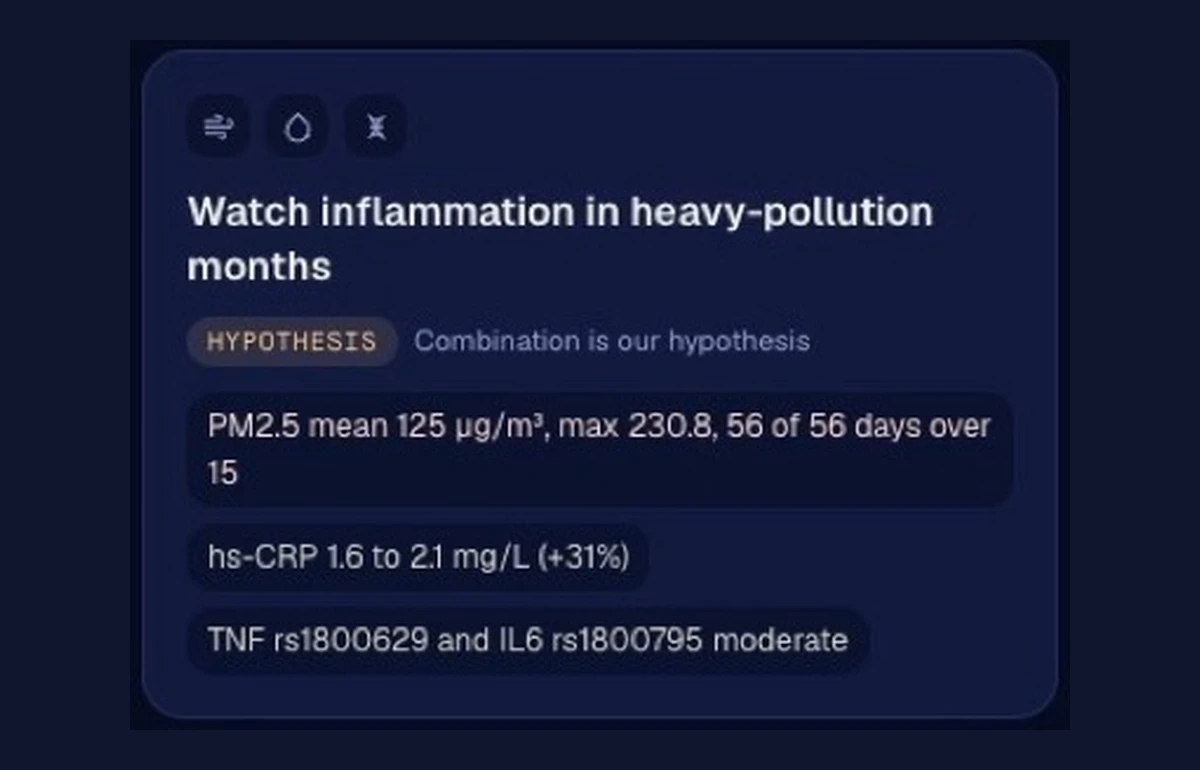
From the demo: three sources on one card, labelled Hypothesis because the combination has never been tested as a whole.
What changes in the day
Habits are the part Alex actually does, and the app checks them against today's air.
Right after the move to New Delhi, Alex's plan includes "Get 15 minutes of outdoor daylight before noon", there for vitamin D. On a day with an air quality index of 191, the app rewrites it for that day only: sit by a bright window instead, with the windows closed.
Later in the demo the same thing happens with a walk. The guided tour adds two new tests, and in the second one hs-CRP is 3.4, above the cut-off. The Lab Agent, VitaCrypt's assistant that reads a new test and drafts a plan (the first piece in this series is about it), adds "Take a 10-minute walk after dinner". In New Delhi it reads: "AQI 191, PM2.5 118 ug/m3 today: do it indoors (stairs, treadmill or a home routine) and keep windows closed." When the air clears, the usual wording comes back. Similar notes appear for high pollen, strong sun and very hot days.
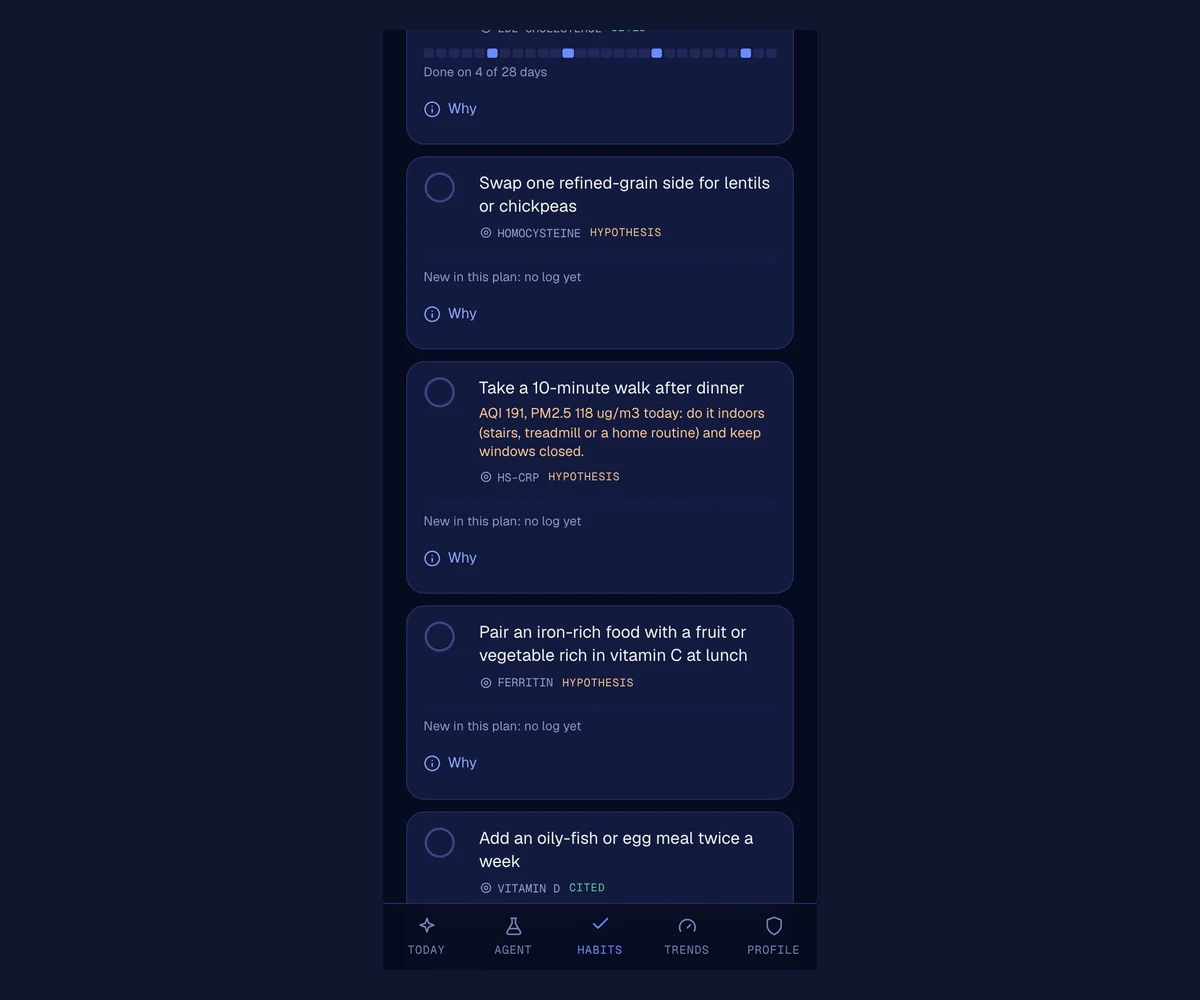
The after-dinner walk on an AQI 191 day, later in the guided tour.
Clean air needs the reverse check, because looking for connections will turn up some there too. So VitaCrypt first checks Alex's own numbers, takes into account whether the air was actually bad, and removes any reason that blames clean air.
The same person in Helsinki
The demo can also move Alex to Berlin, Da Nang or Helsinki, each with its own real archived air, or back to Los Angeles, where Alex starts. The genes and blood tests stay exactly the same.
In Helsinki the eight weeks before the test look very different. Mean PM2.5 was 5.3, and not a single day went above 15, so the app says nothing about air. The problem there is light. The daily peak of the UV index averaged 0.1, while skin needs roughly 3 or more to make much vitamin D. Alex's vitamin D had already dropped from 22 to 16 ng/mL between the first two tests, well under the 30 the app treats as the lower bound. The daylight habit gets its own note there: the sun is too weak for vitamin D, though daylight still helps sleep.
What to keep in mind
Alex's blood, DNA and habits are invented for the demo. The air is real but archived and taken at the city centre, so it says nothing about a particular street or the air inside a flat.
Two hs-CRP values from one person also move with a cold, a bad week of sleep or a hard workout. A Hypothesis card cannot separate the air from everything else that happened that winter. It points at a pattern worth asking about.
VitaCrypt is an early-stage MVP. It gives no diagnosis and no medical advice, and any supplement it mentions is a reference, not a prescription.
Try it
Alex's profile is open to anyone, without an account: app.vitacrypt.xyz/demo. The first load can take about a minute while the server wakes up. Choose "Explore on my own", open Profile, then Environment, and find "See Alex in another city" near the bottom. Move Alex before adding any new test, because the guided tour changes the plan. The cards are not fixed, so the ones you see may differ from the card above.
For a real profile the air comes from your own location, anywhere in the world; pollen data covers Europe only. If you have blood tests, a DNA file or a wearable and want to see them read together, join the waitlist for the first testers at vitacrypt.xyz/agent and choose "User / patient". The form asks for a name, an email and your role, and no health data. The next piece in this series is about what to do between two blood tests.
Need systems like this — or the clients to fill them?